Nauru: which organ?
Martinique: kidney, apparently (also, fœtus, apparently; also, the face on the Corsican flag, in my opinion).
As one can see, they're very similar. Apparently the latter looks like a kidney or a fœtus. I could only find this attested in a novel by John Edgar Wideman, but it may represent a wider folklore - although, I would have expected more hits on a Google search for that.
I was under the impression that there was a description of this in Césaire's Cahier d'un retour au pays natal, however, the quote only goes so far as the following to describe Martinique as a fœtus:
l'archipel arqué comme le désir inquiet de se nier, on dirait d'une anxiété maternelle pour protéger la ténuité plus délicate qui sépare l'une de l'autre Amérique
It is close, but the 'maternal anxiety' which might allude to the fœtus shape of Martinique instead refers to the thin stretch of land between the two Americas. Nonetheless, Césaire uses cartographical imagery as an extended metaphor just after that quote:
Et mon île non-clôture, sa claire audace debout à l'arrière de cette polynésie, devant elle, la Guadeloupe fendue en deux de sa raie dorsale [...] l'Afrique gigantesquement chenillant jusqu'au pied hispanique de l'Europe
Africa is imagined as pushed 'under' Europe's 'foot' - the Iberian peninsula. Guadeloupe, another Caribbean island, is imagined as 'split in two along its backbone'.
This to me looks like a walnut, or a pair of lungs. That is not to undermine the validity of Césaire's description, whose own description works better in the context of his ideology of Négritude, the islands becoming symbols of the oppression of colonialism.
Martinique: kidney, apparently (also, fœtus, apparently; also, the face on the Corsican flag, in my opinion).
 |
| Signor Corsica |
 |
| Martinique silhouette |
As one can see, they're very similar. Apparently the latter looks like a kidney or a fœtus. I could only find this attested in a novel by John Edgar Wideman, but it may represent a wider folklore - although, I would have expected more hits on a Google search for that.
I was under the impression that there was a description of this in Césaire's Cahier d'un retour au pays natal, however, the quote only goes so far as the following to describe Martinique as a fœtus:
l'archipel arqué comme le désir inquiet de se nier, on dirait d'une anxiété maternelle pour protéger la ténuité plus délicate qui sépare l'une de l'autre Amérique
It is close, but the 'maternal anxiety' which might allude to the fœtus shape of Martinique instead refers to the thin stretch of land between the two Americas. Nonetheless, Césaire uses cartographical imagery as an extended metaphor just after that quote:
Et mon île non-clôture, sa claire audace debout à l'arrière de cette polynésie, devant elle, la Guadeloupe fendue en deux de sa raie dorsale [...] l'Afrique gigantesquement chenillant jusqu'au pied hispanique de l'Europe
Africa is imagined as pushed 'under' Europe's 'foot' - the Iberian peninsula. Guadeloupe, another Caribbean island, is imagined as 'split in two along its backbone'.
 |
| 'fendue en deux de sa raie dorsale' |
Now, let's apply the same rhetorical device to Nauru. Let us observe Nauru's silhouette.
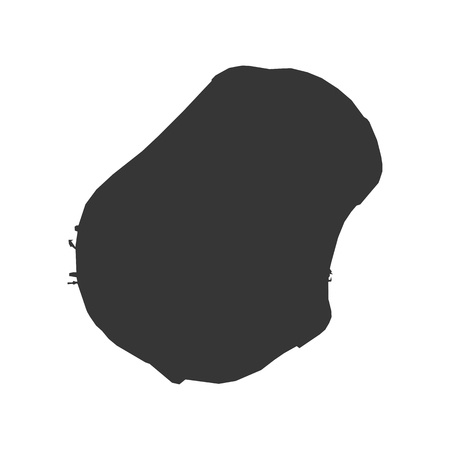
Well, it's a pretty boring, basic round island shape, except perhaps the bay on the right-hand side of our silhouette. But let us now observe Nauru in full colour.

Well, it's a pretty boring, basic round island shape, except perhaps the bay on the right-hand side of our silhouette. But let us now observe Nauru in full colour.
It in observing Nauru in full colour that the image becomes more metaphorically evocative. The roads to and from Nauru's remnant phosphate mine stand out like white veins across the organic surface of the island. Like veins, these roads carried the products of the guano-phosphate mining industry towards leaving the island, the lifeblood of Nauru's economy. Like in the kidney, the veins carry waste product (urea, guano) and then lead it to be expelled from the body (urine, exports).
But, indeed this is no Romantic description. If it is, it is more to the tune of Baudelaire's grotesque Une Charogne than Wordsworth's fanciful I wander'd lonely as a cloud. That bird-shit can be so valuable is indeed akin to the Baudelairean concept of extracting gold from the mud of reality. Nauru's guano-mining, however, was so excessive (80% of its guano has been mined) that there is little left to mine, resulting that the country is now faced with economic decline. In fact, 80% of Nauru's surface has been strip-mined. It is a known truism that Nauru that it went from being one of the richest countries in the world to one of the poorest - this being GDP per capita.
Nauru was once a waste-land full of precious bird-shit, it is now a wasteland void of precious bird-shit, begging the question: Has Nauru got more shit or less shit?
